Spatial memory on a rotating cube: playful, focused matching sessions
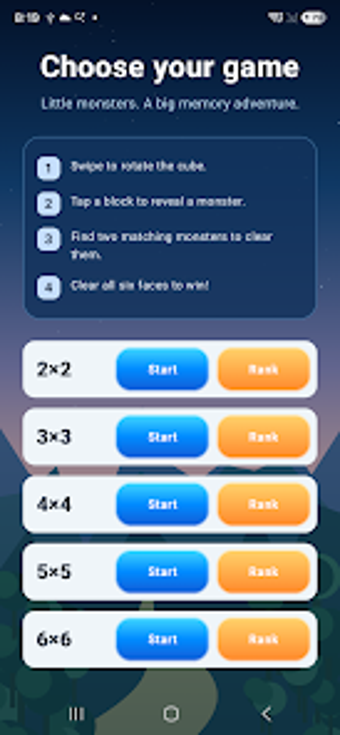
Rotate a 360-degree cube, flip blocks and pair monster icons across multiple planes in a single session. FlipCube3D - Memory Game, from Kim JuYoung, layers classic matching into a three-dimensional puzzle and places progression across five difficulty tiers. The app shows a clear learning curve with 24 to 216 blocks, and it targets puzzle players, children building memory skills, and adults after a calm, focused challenge.
How the 3D twist changes the memory loop
FlipCube3D replaces a flat grid with a multi-faced cube, so the core loop becomes rotate, inspect, flip. Players drag to rotate the cube and tap blocks to reveal monster icons; matches remove pairs until the cube clears. That spatial arrangement forces you to remember positions on different faces, converting simple pair recall into a short-term spatial task that gradually expands as grid sizes increase.
Difficulty scaling and session pacing
The game offers five explicit difficulty levels, moving from 24 up to 216 blocks, which adjusts session length and cognitive load. Early tiers suit short, casual plays while larger grids demand several minutes of focused attention. Progression feels measured because the level sizes incrementally increase the number of blocks rather than changing mechanics, so you scale challenge by choosing a grid size that matches available time and skill.
Audio, visuals, and the control feel
Visual design uses stylized monster icons and a clean presentation that keeps focus on block layouts; the cube rotates with touch-and-drag controls and maintains consistent responsiveness across interactions. Sound cues signal flips and successful matches, adding feedback without pressure. The interface keeps options minimal, so the sensory design emphasizes calm observation rather than frantic input.
Competition and replay incentives
A global leaderboard records high scores, introducing a competitive spur for repeat plays. That competitive layer pairs with the scalable grid sizes: smaller matches suit quick leaderboard attempts, larger puzzles reward long sessions to chase top ranks. Replay value rests on improving recall across orientations and pushing leaderboard standing rather than unlocking new mechanics or content.
Clear pick for focused puzzle sessions, less so for variety hunters
In summary, FlipCube3D suits players who want a compact spatial memory challenge and measurable improvement through larger grids. It rewards repeat practice and leaderboards but offers limited mechanical variety beyond scaling grid size, so players seeking evolving systems or narrative depth may find it narrow in scope.